

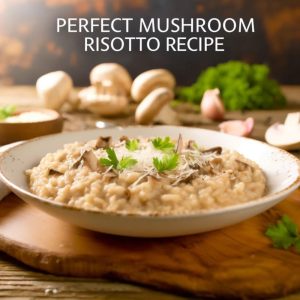
How to Make the Perfect Mushroom Risotto
What is this blog about? This blog is about creating the perfect mushroom risotto.…

Mushroom mushroom culture is a nutrient-rich, sterilized liquid that lets mycelium grow and multiply before you introduce it to grain spawn or substrate. Made correctly, a single 500ml jar of mushroom culture can inoculate 50 or more grain jars or bags, making it extremely cost-effective.
This guide walks through what mushroom culture is, how to make it from scratch, how to keep it healthy, and how to move it from jar to substrate- everything you need, whether this is your first culture or your fiftieth.
Mushroom culture is a sterilized mixture of nutrients, normally sugar at least, and other ingredients as you progress. Instead of starting from scratch, you’re working with mycelium that’s already alive and expanding, which is why mushroom culture has become a staple for most cultivators.
Because the medium is liquid, it expands in 3 dimensions, allowing faster growth and even distribution through a jar; it sterilizes in a pressure cooker, and you can transfer it directly into grain spawn or All-in-One bags through a self-healing inoculation port. This combination of speed, uniformity, and low cost is what sets it apart from traditional solid-media methods.
The main advantage of mushroom culture is time. The mycelium in liquid culture is already active, so colonization begins right away. Mycologist Paul Stamets, in his widely cited 2000 study on mushroom cultivation, found that starting from mushroom culture rather than spores can cut colonization time by more than half. This difference shows up directly in how quickly a batch reaches full colonization and how much room contaminants have to take hold.
Beyond speed, mushroom culture is economical: a small amount of culture goes a long way toward inoculating multiple containers, which lowers the cost per grow compared to running the same volume through agar transfers.

Getting started requires a modest, one-time investment in equipment plus a handful of consumables you’ll restock over time. On the equipment side, you’ll want a pressure cooker or autoclave capable of holding 15 PSI, a scale accurate to the gram, and either a still air box or laminar flow hood to keep your workspace clean during inoculation. Consumables include mason jars with self-healing inoculation ports, sterile transfer tools, alcohol wipes, and your nutrient source of choice.
None of this needs to be expensive to be effective; many successful home cultivators run their entire mushroom culture process with a stovetop pressure cooker and a still air box built from a plastic storage tub.
A standard mushroom culture medium is simple by design: water, a light sugar source, and heat for sterilization. Here’s the ratio most cultivators start with:
Distilled water is important because it’s demineralized. If you use city or well water and it is heavily mineralized, you may see it after sterilization, which can lead people to believe their culture jar is contaminated.
Dissolve the Karo Syrup fully into the water, then pressure cook the sealed jar at 15 PSI for 30 minutes to sterilize it. Once the jar has cooled completely to room temperature, it’s ready to be inoculated with your starter culture.
Honey works as a low-cost substitute for Karo syrup and is popular for beginners since it’s probably already in your pantry. Dissolve 10g of honey into 500ml of distilled water, then sterilize and inoculate exactly as you would with the malt extract version. The two recipes perform similarly; the choice mostly comes down to what you already have on hand and personal preference for consistency and cost.

Contamination is the single biggest risk in mushroom culture work, and nearly all of it traces back to technique during inoculation rather than the recipe itself. Work inside a still air box or under a laminar flow hood, and wipe down your workspace with isopropyl alcohol before you begin. Flame-sterilize any metal tools that will touch the culture, let them cool for a few seconds, then add the starter culture through the jar’s inoculation port and gently swirl to distribute the mycelium evenly through the medium.
Small details matter here: a tool that’s still hot when it touches the medium can damage the mycelium, and an unsterilized jar lid or loose seal is one of the most common sources of contamination in an otherwise careful setup.
Once inoculated, most mushroom strains colonize best at a stable 70–76°F (21–24.4°C), away from direct sunlight and temperature swings. Swirling the jar once or twice a day keeps the mycelium suspended and oxygenated (magnetic stir bars with magnetic stirrers are preferred), which noticeably speeds up growth compared to a jar left completely undisturbed.
Visible cloud-like growth typically appears within two to five days, with full colonization following over about 2 weeks. Patience matters more than intervention at this stage; opening the jar to check on it unnecessarily is one of the easiest ways to introduce contamination.
Foul-smelling liquid almost always signals contamination, and the safest response is to discard the jar and start over with tighter sterile technique rather than try to salvage it. Slow or stalled growth, on the other hand, usually points to temperature or nutrition issues; check that the jar stays in the right range and that your sugar-to-water ratio matches a tested recipe rather than a rough estimate.
If mycelium hasn’t shown visible growth within a week, treat that as a sign something went wrong early on rather than continuing to wait. Test on an agar plate to confirm.

A fully colonized jar of mushroom culture is ready to expand your grow. The most common next step is adding 10ml to sterilized grain to produce grain spawn, which is then used to inoculate bulk substrate. Alternatively, you can add the culture directly to substrate bags or jars if they’ve already been properly sterilized. Either path turns a single jar of mushroom culture into enough spawn to fill several substrate containers, which is where the time and cost savings really compound.
Mushroom culture only performs as well as the genetics and materials behind it. Starting with culture from a trusted supplier removes one of the biggest variables in the entire process, since a contaminated starting culture can undo even flawless technique downstream.


Visible cloud-like growth typically appears within two to five days, with full colonization over about two weeks at 70–76°F (21–24.4°C). If there’s no visible growth within a week, something likely went wrong early.
Not always. Higher-nutrition recipes, powders such as calcium carbonate, and mineral-heavy city or well water can all cause cloudiness. The only way to be sure is to test the culture on agar and see how it grows. Foul-smelling liquid almost always signals contamination.
About 10ml per grain jar or bag. A single 500ml jar can inoculate 50 or more.